
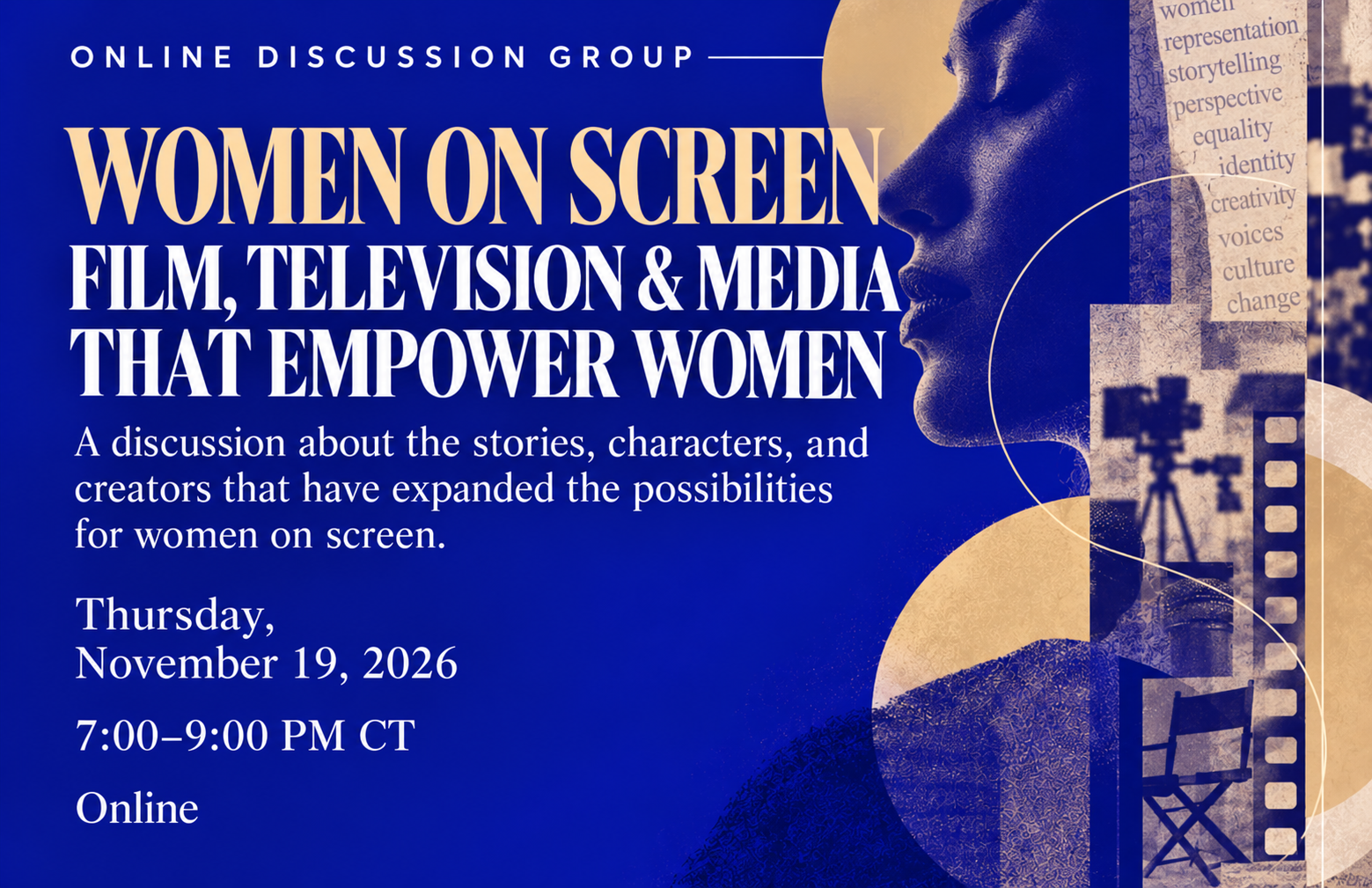
ONLINE DISCUSSION GROUP
WOMEN ON SCREEN
FILM, TELEVISION & MEDIA THAT EMPOWER WOMEN
Thursday, November 19, 2026
7:00–9:00 PM CT
Online
November’s online discussion turns toward the stories that have expanded the possibilities for women on screen.
Film and television have enormous influence over the ways we understand gender, power, beauty, aging, ambition, sexuality, motherhood, friendship, leadership, anger, vulnerability, and independence. For generations, women were frequently positioned as supporting characters in stories centered around men, or confined to familiar roles that offered little room for contradiction or complexity.
That landscape has changed considerably, although not evenly.
This discussion will examine films, television series, documentaries, performances, and other forms of visual media that have allowed women to occupy more complicated territory. We will look at characters who are permitted to be ambitious without apology, imperfect without punishment, funny without becoming caricatures, sexual without existing solely for the male gaze, older without disappearing, and powerful without being required to become traditionally masculine.
We will also ask a more difficult question: What does it actually mean for media to “empower” women?
Is a strong female character necessarily an empowered one? Does empowerment require triumph? Can a deeply flawed or even unlikeable woman represent progress simply because she is allowed the same narrative complexity traditionally afforded to male characters?
The conversation will move beyond individual characters to consider who is creating the stories themselves. Women writers, directors, producers, actors, documentarians, and showrunners have increasingly changed not only who appears on screen, but whose perspective determines how a story is told.
SPEAKER & FACILITATOR
Erin McGrath Rieke
Artist, writer, mental health advocate, peer counselor, and founder of Just E Productions
Erin will open the evening with a brief presentation exploring the evolution of women in film and television, the cultural expectations placed on female characters, and examples of storytelling that have challenged traditional representations of women.
The remainder of the evening will be an open, facilitated conversation among participants about the films, television programs, performances, and characters that have influenced the way we think about women.
ATTENDEES
This discussion is open to adults interested in film, television, media, gender, culture, storytelling, feminism, representation, and the changing ways women are portrayed on screen.
You do not need professional or academic experience with film or media studies to participate.
Participants are encouraged to come prepared with a film, television series, documentary, performance, character, writer, director, or creator they believe has contributed something meaningful to the representation of women.
You are equally welcome to attend simply to listen.
EVENING SCHEDULE
7:00–7:10 PM | Welcome & Introductions
Introductions, overview of the evening, and an opportunity for participants to briefly share a film, television series, character, or performance that has stayed with them.
7:10–7:30 PM | How Women Have Been Written
A brief look at the evolution of women in film and television and some of the recurring roles women have historically been expected to occupy.
We will consider how familiar archetypes such as the wife, mother, ingénue, femme fatale, victim, caretaker, romantic interest, and “strong female character” have shaped cultural expectations about women.
We will also examine what happens when writers and filmmakers begin allowing women to exist outside those categories.
7:30–7:50 PM | Opening Presentation
Women on Screen: Power, Complexity & Representation
We will consider:
• what makes a female character feel fully realized rather than symbolic
• the difference between strength and empowerment
• ambition, anger, sexuality, vulnerability, motherhood, and independence on screen
• aging and the visibility of women beyond youth
• the cultural expectation that female characters remain likeable
• the difference between being the subject of a story and simply appearing within it
• the influence of women writers, directors, producers, and showrunners
• how race, class, sexuality, disability, identity, and cultural background affect which women are represented and how their stories are told
7:50–8:15 PM | Film & Television Discussion
A facilitated conversation about portrayals of women that have challenged expectations or changed the way participants thought about female characters.
Questions may include:
Which female characters have stayed with you long after the story ended, and why?
What makes a portrayal of a woman feel honest rather than idealized?
Why are complicated male characters often celebrated while complicated women are still described as unlikeable?
Can a character be empowering even if she makes terrible decisions?
How has the portrayal of women over forty, fifty, or sixty changed on television and film?
What happens to a story when women are writing, directing, or producing it?
Are there films or television series you understand differently now than when you first watched them?
8:15–8:25 PM | Break
Participants are encouraged to step away, get water, stretch, or simply take a few quiet minutes before we continue.
8:25–8:50 PM | Open Group Discussion
Participants will be invited to bring their own examples into the conversation.
We may discuss beloved characters, performances that challenged us, films we once admired but now view differently, stories that surprised us, and representations that still feel limited or frustrating.
The goal is not to create a definitive list of “empowering” media.
In fact, some of the most interesting examples may be the ones we disagree about.
Instead, we will consider what it means for women to be given enough narrative space to be complicated, contradictory, ambitious, selfish, tender, difficult, frightened, powerful, uncertain, funny, aging, sexual, imperfect, and recognizably human.
8:50–9:00 PM | Closing Conversation & Recommendations
We will close by sharing films, television series, documentaries, performances, writers, directors, and creators participants would recommend to one another.
We will also consider a final question:
What kinds of women’s stories do we still want to see?
Participants will leave with a collaborative list of viewing recommendations gathered throughout the evening.
COMMUNITY AGREEMENTS
This is an open and respectful discussion.
Participants are encouraged to disagree thoughtfully, remain curious about perspectives different from their own, and allow room for complexity.
Criticism of a film, character, creator, or cultural idea is welcome. Personal attacks are not.
Participants should be mindful that discussions of film and television may involve references to sexism, sexual violence, domestic violence, discrimination, body image, trauma, reproductive issues, mental illness, and other potentially sensitive subjects.
No participant will be expected to disclose personal experiences.
Listening is participation.
You may step away from the conversation at any time.
CONTENT NOTICE
This discussion may include references to sexism, misogyny, sexual assault, domestic violence, harassment, discrimination, reproductive issues, mental illness, body image, trauma, and other subjects depicted in film and television.
Please participate in whatever way feels appropriate for you.