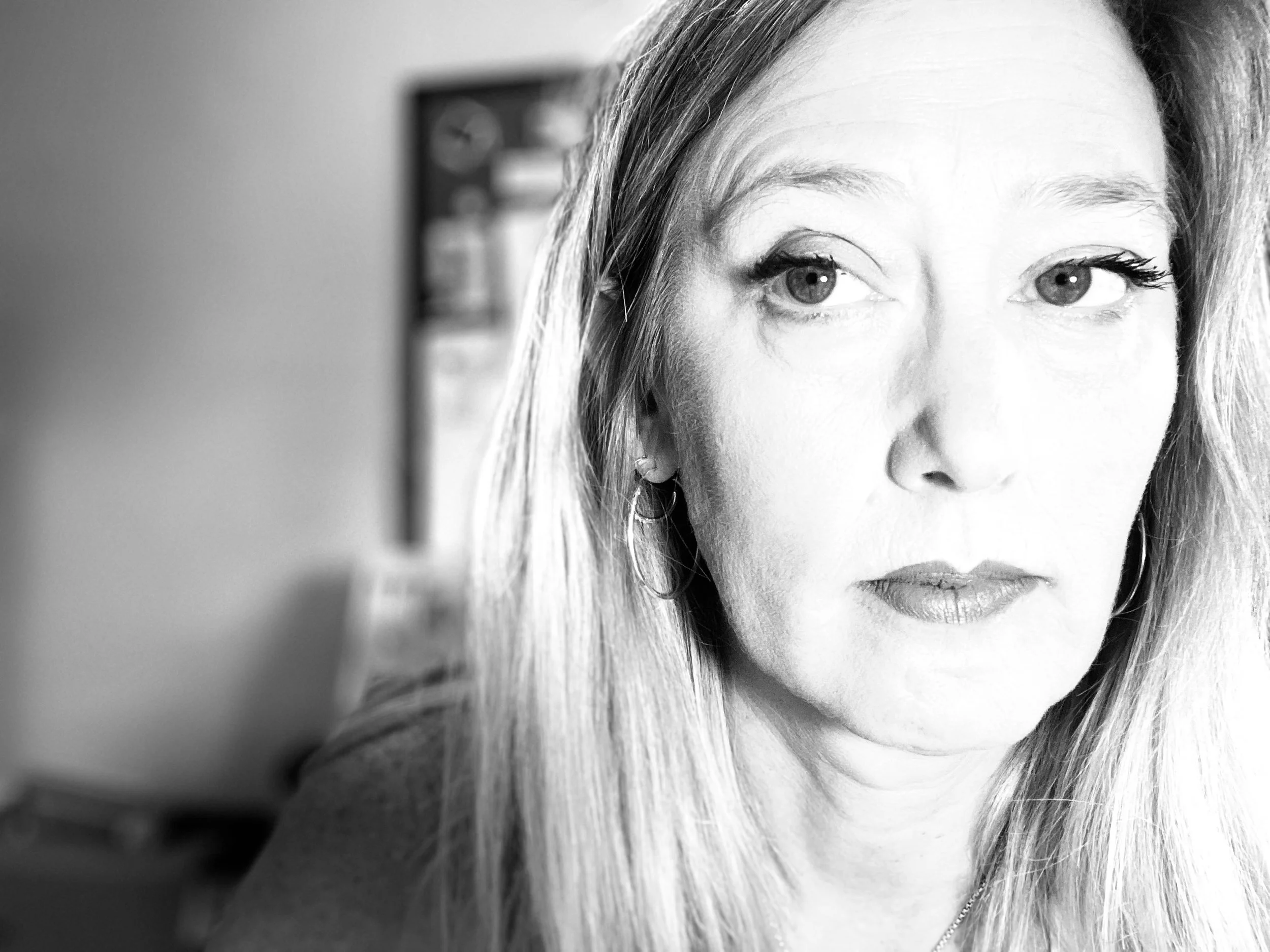
I Am.
Lately, life has felt calm in a way I do not entirely trust. Not suspicious, exactly, but alert. Calm like a lake that has stopped moving long enough for you to see your own reflection and realize you have not looked at your own face in a while. Things are working. The days hold their shape. Paul and I wake and sleep without friction, and even my thoughts arrive less like storms and more like weather patterns I recognize. I notice this because it is unfamiliar. For most of my life, stability felt fictional, something other people staged for photographs. I grew up inside emotional motion, the kind that teaches you early that stillness is dangerous. When things go quiet, my instinct is not gratitude. It is inventory. What did I miss. What is waiting. What part of me is about to fall through the floor.
There is a version of adulthood we are taught to want. The steady relationship. The coherent identity. The manageable future. You move through your days like a professional, collecting meaning without bleeding for it, carrying your history the way people carry luggage, something you own but do not open in public. I tried to live that version for a long time, and for a while I almost believed in it. But calm, when it arrives honestly, does something else. It does not erase the past. It invites it to sit down. It creates room for old selves to reappear, not as problems but as witnesses. Lately, in the quiet hours between work and sleep, I have been meeting them again. The girl who learned to listen before she learned to speak. The woman who painted when she could not explain. The patient who memorized her symptoms like a second language. The mother who kept moving even when her sense of direction failed. They show up unannounced in the kitchen light, in the studio, in the moments when Paul reaches for my dog’s leash and does not realize he is touching something sacred to me.
My dog has always been more than companionship. He is continuity. He is the animal version of survival. He saw me when I was unrecognizable to myself, when language fell apart, when the future became theoretical, when mornings felt like negotiations. Watching Paul kneel beside him now, adjusting his collar, whispering to him like you would to someone you love without conditions, I feel time compress in a quiet, physical way. Not nostalgia, not fear, but recognition. The sense that the present is never separate from what came before it. It is layered on top of it. We talk about the present as if it exists alone, but it never does. It is built from accumulation, from decisions we barely remember making, from habits formed in crisis that we later mistake for personality.
Paul and I did not arrive at ease by accident. We learned each other slowly through wrong tones, through misunderstandings that felt personal when they were mostly human, through the kind of years where love does not look cinematic but logistical. Love that looks like staying when the story stops entertaining you. There is a fantasy that good relationships are instinctive, that compatibility reveals itself early and cleanly. In reality, intimacy is trained. It is practiced like a craft. You learn when to speak, when to soften, when to stop narrating your own pain and start listening to someone else’s. We are calmer now because we are less performative. We no longer try to prove what we feel. We inhabit it.
But calm always carries a question with it. Once the noise recedes, what do you hear. For me, the answer is memory, not dramatic memory that begs for resolution, but the physiological kind. The way my body remembers instability even when my life stops producing it. I still scan rooms. I still listen for emotional shifts before they happen. I still wake some mornings already tired, as if my mind ran marathons while I slept. This is the afterimage of a life lived in adaptation mode. For years, I believed I was broken, that my mind arrived defective, that my emotional velocity was an error to be corrected with precision and authority. So I entered systems designed to manage chaos and became, in many ways, a living experiment in learning how much of a person could be altered without erasing them.
Medication helped me survive, and it also taught me how easily identity becomes negotiable. How quickly intuition is replaced by compliance. How the vocabulary of healing sometimes silences the very questions it is meant to answer. I learned to describe myself in terms of symptoms. I learned to trust charts more than instincts. I learned to ask permission to feel. There were years when my emotional range narrowed so much I mistook flatness for peace. I moved through my days like a woman underwater, aware of beauty but separated from it by a membrane I could not puncture. And still, somewhere underneath, the artist kept whispering.
She whispered in colors, in unfinished canvases, in journals written too late at night when performance fell apart and honesty slipped through. Art became the only place where I did not have to behave. When I painted, I was not managing myself. I was listening to pressure, to mood, to memory that lived in the muscles instead of the mind. Every piece was less about what happened and more about what vibrated while it was happening. I did not paint landscapes. I painted interior weather. Writing did something different. It interrogated. Painting let me feel. Writing asked me why.
There are notebooks in my house that still make my hands hesitate. Pages written by versions of me I barely recognize but somehow trust more than my current voice. Women who did not know how things would turn out and therefore told the truth without marketing it. Sometimes I open one and feel embarrassed, not because the writing is bad but because it is unguarded. It does not flatter survival. It documents confusion the way a camera documents light. Those pages remind me that identity is not linear. We do not become better. We become more aware. We carry every former self forward, even when we pretend we outgrew them.
Stability, I have learned, is not the absence of struggle. It is the ability to sit with your own history without trying to rewrite it into something inspirational. Chaos keeps you moving. Stability makes you reflective. Reflection is intimate work. Lately, when life feels easy, I notice my instinct to narrate the future, to ask what comes next, to treat calm like a temporary exhibit instead of a lived environment. For years, I believed preparation meant control. If I thought far enough ahead, planned deeply enough, protected myself thoroughly enough, then pain would become optional. What I have learned instead is that adaptability matters more than foresight. You cannot predict a life. You can only train yourself to meet it honestly.
That training happens in small moments. In watching someone love what once protected you. In letting silence stay silent. In noticing when your mind wants drama because peace feels unfamiliar. Sometimes, when Paul and I sit together at night, the room dim and ordinary, I feel a strange tenderness toward my own nervous system, toward the part of me that still waits for disruption. I want to tell her that she does not have to audition for catastrophe anymore, that safety does not require rehearsal. But change is slow, especially the internal kind. We are shaped less by what happened to us than by what we learned to expect afterward.
I learned to expect volatility. I learned to expect disappearance. I learned to expect that the self I woke up as might not be the one I went to sleep with. So when life finally offers coherence, my first response is disbelief, my second gratitude, my third curiosity. Who am I without emergency. Who am I without escalation. Who am I when the story does not demand heroics. The answer is quieter than I expected. I am someone who likes mornings now. Someone who paints without apology. Someone who writes without asking if the feeling is legitimate. Someone who watches her life instead of racing through it.
This does not mean the past dissolved. It lives with me in my posture, in my patience, in the way I still listen harder than I speak. But calm has changed its role. It is no longer the pause before collapse. It is the space where I learn what I am capable of sustaining. For a long time, survival was my only talent. I knew how to endure, how to adapt, how to keep moving even when meaning thinned out. What I am learning now is how to remain. To remain inside joy without sabotaging it. To remain inside stability without romanticizing its end. To remain inside myself without constantly asking permission from history.
The future still feels uncertain. Of course it does. Uncertainty is not a flaw. It is the architecture of being alive. But uncertainty no longer feels like a threat. It feels like invitation, an invitation to participate instead of predict, to notice instead of narrate, to trust the present without demanding it guarantee the future. Sometimes, late at night, when the house is quiet and the studio smells faintly of paint and paper, I think about how strange it is that we spend so much of our lives preparing for something instead of inhabiting what is already here. We rehearse happiness. We postpone presence. We treat stability like a waiting room instead of a destination.
But what if this is the destination. Not perfection. Not resolution. Not safety without cost. Just a life where you can look at your own reflection and recognize the woman staring back. Where you can remember who you were without needing to become her again. Where you can love without bracing. Where you can stand in the ordinary hours of your life and feel something rare and radical underneath them. Permission. Not permission to succeed or transcend, but permission to stay. And maybe that is what calm is really offering me now, not an answer about what comes next, but a quieter, more difficult question. What if nothing needs to come next at all. What if the work is not becoming someone else, but finally learning how to live as the person I already am.